

FH USU Students Win Two Awards at ABLC 2026
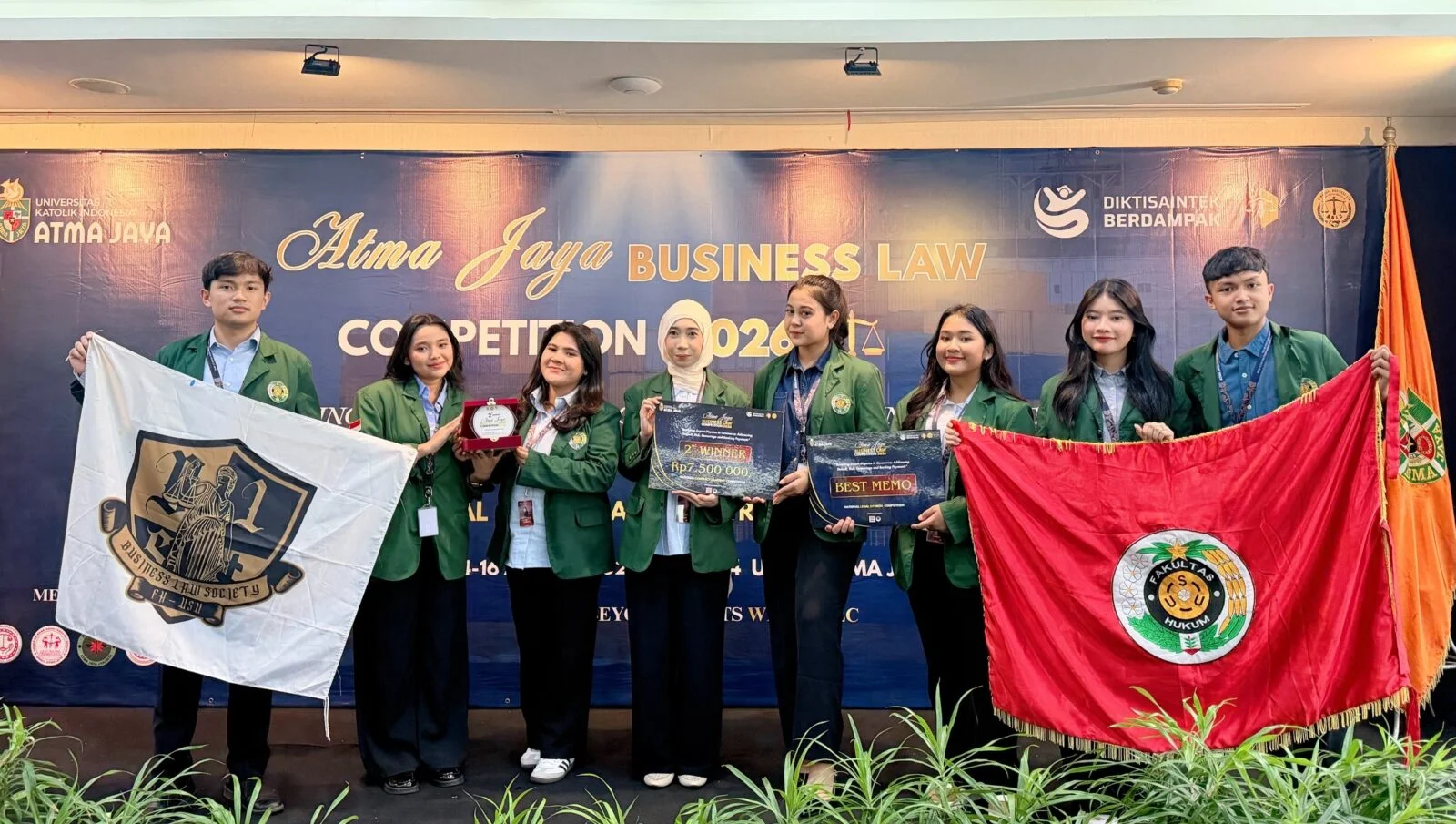


FH USU Students Win Two Awards at ABLC 2026
Published by
Raisha Andini
Published at
Thursday, 10 September 2026


USU PUBLIC RELATIONS – Students of the Faculty of Law of Universitas Sumatera Utara (FH USU) once again demonstrated their academic capabilities in a national-level law competition. At the Atma Jaya Business Law Competition (ABLC) 2026, the FH USU delegation won Best Memorandum in the Legal Opinion Competition category and 2nd Place in the Contract Drafting Competition category.
Held at Universitas Katolik Indonesia (Unika) Atma Jaya on Sunday (August 16, 2026), the competition brought together law students from universities across Indonesia. The two awards earned by FH USU reflected the participants’ ability to analyze legal issues, develop sound arguments, and present them in systematic legal documents.
FH USU sent two teams to the competition. The Contract Drafting Team consisted of Erica Cerelia Sitompul as team leader, Zio Safta Arroyan Ratta, Dhita Natannia Riaogi Sihombing, Mardina Anindhitha Kusumadewi, Felesia Rotua Simanjuntak, and Rivaldo Ferdinand T. Meanwhile, the Legal Opinion Team was led by Zepanya Reh Ulina Br. Bangun, with Gita Lucia Gultom as a member.
ABLC is an annual business law competition organized by the Atma Jaya Business Law Society (ABLS), Faculty of Law, Universitas Katolik Indonesia Atma Jaya. The competition is designed to bring together students’ academic capabilities and legal issues that require professional analysis and solutions.
This year’s competition featured two categories: the Legal Opinion Competition and the Contract Drafting Competition. Both categories required participants not only to understand legal theory but also to apply it in developing arguments and preparing legal documents appropriate to the given cases.
Deepening Contract Drafting Skills through Competition
Erica Cerelia Sitompul, leader of the Contract Drafting Team, said that participating in ABLC 2026 provided her team with an opportunity to deepen its contract drafting skills. According to her, contract drafting is an important area for law students to understand, although it has not yet been explored extensively in regular coursework.
“This competition also provided us with a valuable opportunity to test how well we could apply our understanding of contract law in practice,” said Erica.
The team prepared for the competition by dividing responsibilities according to each member’s strengths. They then conducted research together and developed the contract draft in stages. Each section of the draft was reviewed through several rounds of evaluation before being presented in the competition.
Rather than focusing solely on dividing tasks, all members also sought to understand the contract in its entirety. Regular discussions and presentation practice were conducted to ensure that every member was able to explain the overall substance of the document they had developed together.
Time management was one of the challenges they faced during the process. Academic activities continued alongside competition preparations, prompting the team to establish a regular discussion schedule and maintain communication to ensure that every stage was completed according to plan.
Erica considered the strong teamwork among the members to be one of their main strengths throughout the competition.
“We believe the key factors were team cohesion and good communication throughout the preparation process. Each member complemented one another and remained open to feedback, so the final result was the product of solid teamwork rather than an individual effort,” she said.
She added that participating in the competition provided broader experience, particularly in managing time, developing critical thinking, receiving feedback, and having the courage to explore areas that are not frequently encountered in the classroom.
Testing Analytical Skills through Legal Opinion
The Legal Opinion Team, consisting of Zepanya Reh Ulina Br. Bangun and Gita Lucia Gultom, faced a different set of challenges. In this category, participants were required to analyze legal issues comprehensively, from identifying legal issues and determining the applicable legal basis to connecting facts with relevant provisions and formulating solutions.
Before working on the assigned case, the two team members strengthened their understanding of the topic by consulting various sources. Their research involved reviewing books, accredited journals, legislation, and relevant international provisions related to the legal issues presented.
After receiving the case, the team mapped the parties involved, their legal relationships, the sequence of transactions, and potential disputes. Each issue was then matched with the relevant legal basis and further tested against the facts presented in the case.
“This process ultimately helped us produce a systematic and applicable submission, which earned us the Best Memorandum award,” said Zepanya and Gita.
The complexity of the case and the limited time available presented additional challenges for the Legal Opinion Team. To ensure that their arguments remained focused, they repeatedly reviewed the legal relationships among the parties, the transaction chronology, supporting documents, and payment mechanisms outlined in the case.
A clear division of responsibilities also supported the process. Research, legal relationship mapping, document preparation, and testing potential weaknesses in their arguments were carried out collaboratively, while allowing each member to provide input.
For Zepanya and Gita, their success was not determined by individual ability alone, but by the team’s ability to bring together different ways of thinking.
“If we had to choose the single most important factor, we would say it was not about who was the smartest person on the team, but how well we could make everyone think and work as one team,” they explained.
Competition as a Learning Space Beyond the Classroom
For the FH USU delegation, ABLC 2026 was not merely an opportunity to pursue an achievement. The competition provided a space to test legal knowledge in situations different from classroom learning, while also developing teamwork skills and the ability to defend arguments under pressure.
Zepanya and Gita encouraged other law students not to let a lack of experience become a reason to avoid competitions. According to them, skills can grow when students are willing to participate and commit themselves to the preparation process.
“Do not be afraid to ask questions, do not be afraid to discuss, and do not be afraid to receive criticism. Within a team, do not assume that our arguments are always correct. In fact, when our arguments are challenged by our teammates, we have an opportunity to improve them before they are challenged by our opponents,” they concluded.
They also emphasized the importance of building a team with people who are willing to learn and remain open to constructive criticism. After all, the process of a competition is not only about the final result, but also about how every member grows together.
“Great people do not grow through ease, but through their willingness to make an effort, persevere, and never give up when facing every step of the process,” Zepanya and Gita concluded.


